Conference Agenda

6th October 2026 | London + Virtual

We are excited to release a draft version of the agenda.

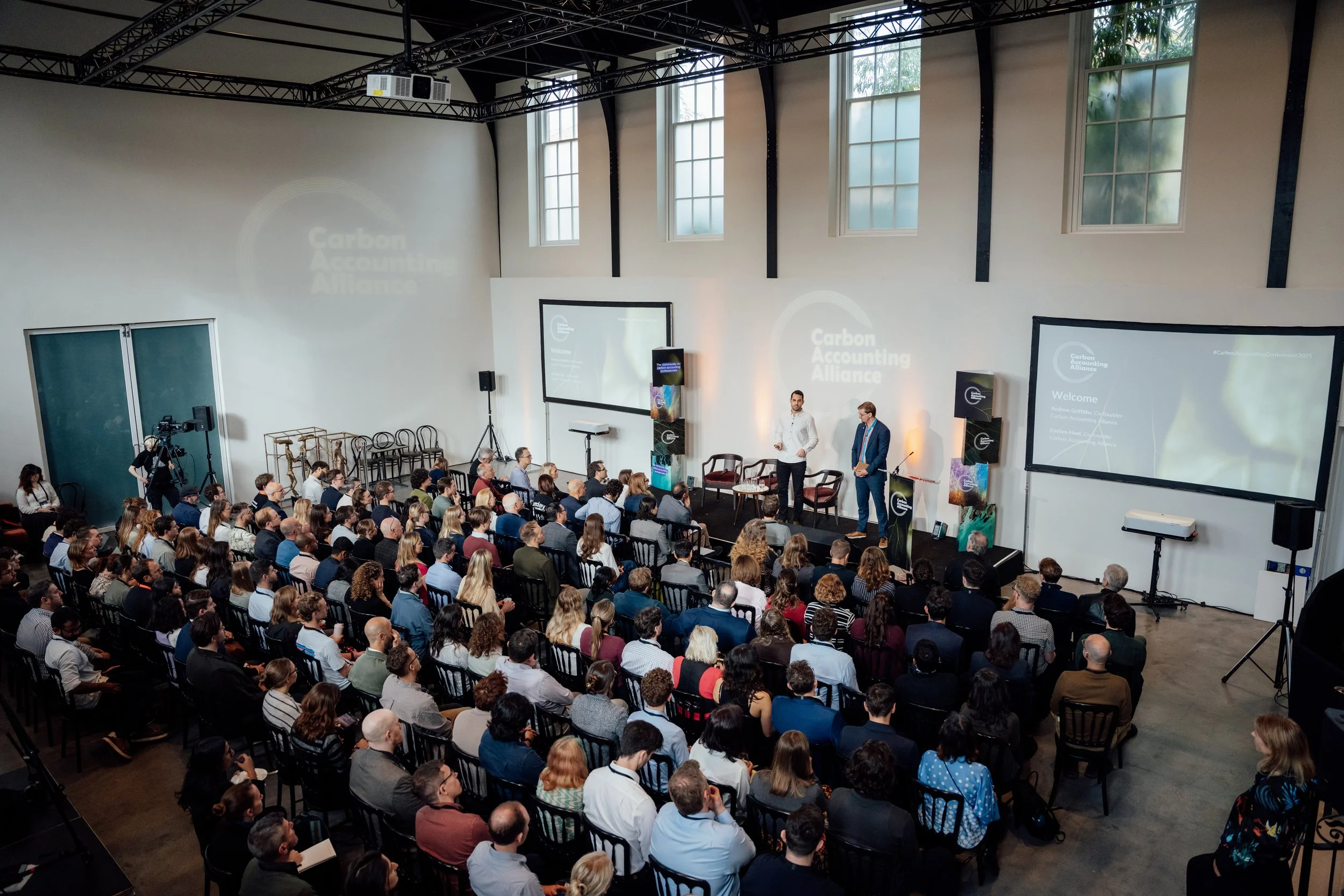
We are hoping for this to be one of the most interactive events in the sustainability circuit this year, with lots of different formats, including roundtable discussions, clinics, different tracks and even an Unconference session, where the topics and format will be entirely decided by delegates, aided by some facilitation. We are still searching and in the process of confirming a number of speakers, and welcome your submission for specific topics as well as general feedback. Please use the form below.

The sessions will be recorded and made available to all delegates (in-person and virtual).

Click on session titles marked with i to view full descriptions

08:30
Arrival, Registration & Coffee
09:30
Welcoming Remarks & State of the Industry
Andrew Griffiths & Emilien Hoet, Co-Founders of CAA
Beveridge Hall
10:00
Keynote
Speaker TBC
10:15
Panel: Is the Current Net Zero Paradigm Helping or Hindering Climate Action?
Kaya Axelsson (University of Oxford), Paul Dickinson (Outrage & Optimism). Moderator TBC
Beveridge Hall
11:00
Break
11:30
Presentation & Q&A: In Conversation with the Standards
Maia Kutner (Global Director, GHG Protocol). SBTi Speaker TBC. ISO Standards Speaker TBC
Beveridge Hall
12:10
Panel: Pragmatism Over Perfection, Making PCFs Work at Scale
Hessam Lavi (CEO & Co-Founder, Climatiq), Representative from PACT. Moderator TBC
Beveridge Hall
12:45
Afternoon Briefing
Andrew Griffiths & Emilien Hoet, Co-Founders of CAA
12:50
Lunch

13:45 - 15:00
Choose Your Track
Two parallel sessions running simultaneously
Roundtables
Delegates will be divided into small groups of up to 10 to discuss key challenges in carbon accounting. Select your topic ahead of the event.
Beveridge Hall, Chancellor's Hall & Virtual
Clinic
A hands-on clinic for practitioners working through Product Carbon Footprint challenges.
Woburn Suite. Not recorded
15:00
Break
15:30 - 17:00
Choose Your Track
Three parallel tracks running simultaneously
New Thinking
15:30 - 16:15
How Can We Professionalise Our Industry Whilst Achieving Scale?
Tamara Somers (General Manager, Sustainability & Impact, Xero). Additional speakers TBC
16:15 - 17:00
How to Leverage AI in Carbon Accounting
Speakers TBC
Beveridge Hall. Recorded
Practical Skills
15:30 - 16:15
How to Match the Accounting Method to the Decision You're Making
Matthew Brander (Chair of Carbon Accounting, University of Edinburgh)
Chancellor's Hall. Recorded
The Unconference
15:30 - 17:00
Delegate-Led Unconference
Topics and format decided by popular vote. Delegates pitch ideas, vote, then break into small group discussions. Under Chatham House Rule.
Woburn Suite. Max 50 delegates. Not recorded

17:05
A Delegate-Led Closing Plenary
Andrew Griffiths & Emilien Hoet, Co-Founders of CAA
Beveridge Hall
17:30
Drinks & Networking
19:00
Afterparty

Welcoming Remarks & State of the Industry

A warm welcome from CAA co-founders with a mindfulness exercise and scene setting for the day. This will include a summary of some of the key challenges, insights and statistics on the state of the carbon accounting industry, following a 3-month research project led by the CAA.

Panel: Is the Current Net Zero Paradigm Helping or Hindering Climate Action?

Five years on from the SBTi Net Zero Standard, the consensus is fracturing. The upcoming ISO Net Zero Standard proposes allocating carbon budgets by country, sector and size, a sharp departure from the one-size-fits-all 90% reduction orthodoxy. New frameworks like Carbon Measures are drawing both interest and backlash. And a growing chorus argues that corporate net zero as currently defined is actively slowing climate action by blocking near-term ambition and putting too much emphasis on reporting emissions that cannot easily be acted on.

This panel brings together leading voices to interrogate the foundations: does organisational net zero still tally with country-level targets and the global carbon budget? How should the "net" be handled? Are the emerging standards converging on something coherent, or pulling in incompatible directions? And what would a more honest, more effective paradigm actually look like?

Presentation & Q&A: In Conversation with the Standards

A candid conversation with the people behind the standards that underpin our work. An opportunity to hear directly from the GHG Protocol, SBTi and ISO about what is coming next and to put your questions to them.

Panel: Pragmatism Over Perfection, Making PCFs Work at Scale

Product Carbon Footprints are supposed to be driving decarbonisation. Instead, for many companies, they have become a bottleneck: tangled in methodological debates, often expensive and manual. This panel brings together a standards body, a technology provider, and a practitioner to ask: how do we close the gap between ambition and adoption?

Roundtables

Small Group Discussions

Delegates will be divided into small groups of up to 10 people to discuss key questions and challenges faced in the carbon accounting industry today. Topics include EACs, BVCM and removals, LCA at scale, emission factors, PCF harmonisation, scenario analyses and more. Delegates must select their topic ahead of the event.

Clinic

PCF Clinic with Climatiq

A hands-on clinic for practitioners working through Product Carbon Footprint challenges. Bring your real-world PCF questions and work through them with support from Climatiq.

Track 1: New Thinking

How Can We Professionalise Our Industry Whilst Achieving the Scale We Need?

Carbon accounting is at a crossroads. Investors, regulators and boards increasingly expect emissions data to meet the same rigour as financial data. The launch of the RCAA professional register is a landmark step. But professionalisation creates a tension: the industry needs to scale rapidly to meet demand, yet higher standards risk creating bottlenecks. This session explores how we navigate that tension and what it means practically for everyone in the room, whether you are an independent consultant, an in-house sustainability lead, or a service provider trying to hire.

Track 1: New Thinking

How to Leverage AI in Carbon Accounting

AI is reshaping carbon accounting, but between the hype and the reality, what does it actually look like in practice? This session brings together a variety of voices to share real-world examples of how AI is being applied across emissions measurement, data quality, and reporting. Expect honest accounts of what is working, what is not, and where the technology genuinely accelerates progress versus where it introduces new risks around transparency and over-reliance on automated outputs.

Track 2: Practical Skills

How to Match the Accounting Method to the Decision You're Actually Making

Corporate GHG inventories answer one question: what emissions should we attribute to this organisation? But that is a different question from: will this decision actually reduce emissions in the real world? In this session, Matthew walks through his thinking comparing attributional corporate accounting, consequential life cycle assessment, and project/policy-level accounting, using case studies to show where the three methods give strikingly different answers.

The session will also cover the GHG Protocol's proposals for "multi-statement" disclosures, including the introduction of a consequential statement alongside the traditional attributional inventory. What does this mean in practice and how should practitioners prepare?

Track 2: Practical Skills

How to Establish an Internal Carbon Price and Construct Carbon Abatement Curves

An internal carbon price is one of the most powerful and underused tools sustainability leaders have for shifting how their organisations make decisions. But setting one that is credible, defensible, and actually influences behaviour is harder than it sounds. This session walks through the practicalities: how to arrive at a price that reflects your risk exposure and decarbonisation ambitions, how to build abatement curves that help you prioritise where to invest, and how to frame both in language that finance teams and boards will take seriously.

Track 2: Practical Skills

How Can We Make Carbon Data More Inspiring?

Calculating emissions is the easy part. Making the complex science accessible and inspiring change is much harder. This session gives practical examples of how we can bring carbon accounting data and insights to life to maximise their impact.

Track 3: The Unconference

Delegate-Led Unconference

A highly interactive delegate-led session where topics and format are decided by popular vote. Delegates pitch ideas (30-second pitches), followed by voting and separation into 4-5 small group discussions. All under Chatham House Rule. Maximum 50 delegates. This session will not be recorded.

A Delegate-Led Closing Plenary

Andrew and Emilien will facilitate a delegate-led conclusion of the day, covering outcomes for us as a carbon accounting community and hopes for the future of the industry. A highly interactive closing plenary session you do not want to miss.

Some of our speakers